What Is Autistic Culture? The 10 Pillars That Define a Living Community
Autistic Culture is a rich, historic, and living community shaped by shared values, norms, and traditions that differ from neurotypical norms — defined not through a medical or diagnostic lens, but from the inside out.
The 10 Pillars of Autistic Culture were developed by Dr. Angela Kingdon, a cultural psychology educator with over 40 years of experience translating cultures. Drawing on that deep expertise — and on her own lived experience as a late-diagnosed Autistic person — she articulated a framework that describes Autistic culture from the inside out, grounding it in the shared values, norms, and meaning-making practices that actually emerge from the Autistic neurotype, rather than imposing an external, deficit-based lens.
The term Autistic Culture has documented roots stretching back at least to 1999, when it appeared at Autreat, an Autistic-run retreat and conference. At that event, Kim Duff — a linguistics and anthropology student and ANI-L member diagnosed in 1998 — presented "The Role of Changeling Lore in Autistic Culture," exploring how changeling mythology functioned as a means of self-identification within the Autistic community. The recognition of a distinct Autistic culture did not originate with clinical researchers; it emerged from Autistic people themselves.
The 10 Pillars of Autistic Culture define the community not through a medical or diagnostic lens, but by establishing the shared values, norms, traditions, and modes of meaning-making that naturally emerge from the Autistic neurotype. They represent the broad strokes of how Autistic people perceive the world, regulate their nervous systems, build connections, and create.
Autistic culture is often misunderstood and misrepresented by outsiders, similar to how other cultural groups have been historically mischaracterized. Autistic traits have existed throughout history, evidenced by notable figures and behaviors predating the term "autism." The foundation of Autistic culture is rooted in shared experiences, values, and inherited meanings that go beyond diagnostic labels. Dr. Angela Kingdon's work emphasizes the importance of viewing autism as a culture rather than solely a disorder — highlighting the need for genuine cultural competency in healthcare, education, and the workplace.
The 10 Pillars of Autistic Culture
Bottom-Up Processing
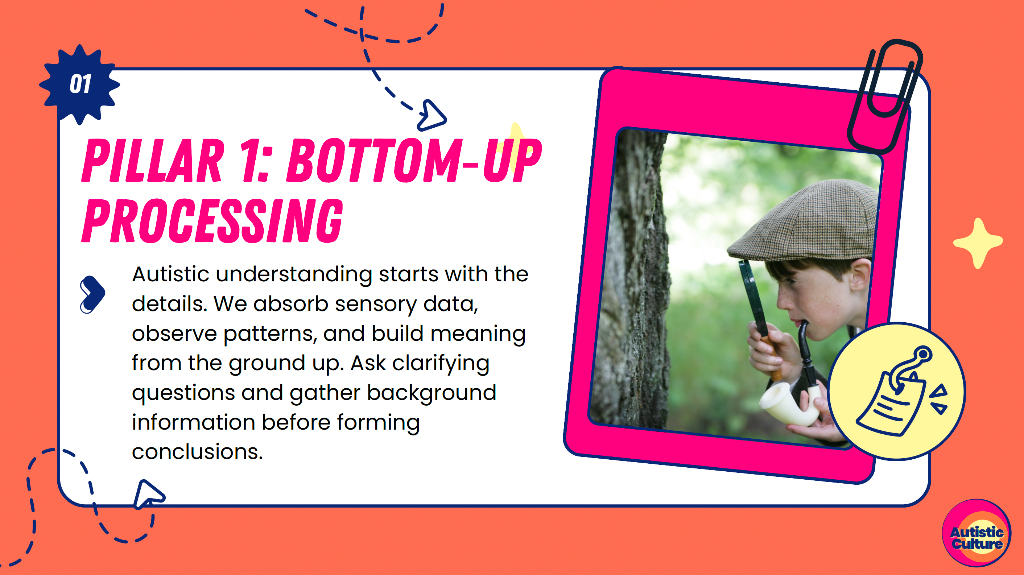
As the operating system of Autistic Culture, this pillar defines how Autistic individuals experience the world by gathering specific details first to build an overarching understanding, rather than relying on top-down assumptions or social implications. It creates a cultural preference for direct communication, precision, and truth, which can make typical neurotypical environments—which demand fast, abstract decision-making—exhausting.
Rhythmic Communicating
This pillar reclaims behaviors often pathologized by the medical model—such as echolalia, scripting, tangents, and info-dumping—as legitimate, deeply meaningful forms of expression and connection. These rhythmic patterns serve to regulate emotions, bridge spontaneous speech for Gestalt language processors, and build bonds through the generous sharing of intense special interests (SPIN bonding).
Norm-Challenging
Autistic Culture is characterized by a natural resistance to arbitrary social rules, unspoken hierarchies, and behavioral defaults. Because Autistic people require things to be logically true and coherent, they often question authority and refuse to pretend to accept systems that do not make sense, making them innate challengers of the status quo.
World-Building
Whether designing fictional universes, organizing physical spaces, or creating specialized routines, Autistic people are driven to construct environments and systems that are reliable, internally consistent, and safe. This is not an escape from reality, but a necessary response to an external world that often feels overwhelmingly fast, contradictory, or hostile.
Pattern-Matching
Rather than just a cognitive skill, pattern-matching is an Autistic cultural instinct used to detect structure, trace cause-and-effect, and identify contradictions. It is a primary method for learning and evaluating trust; Autistic people build coherence from chaos by tracking how details interact over time, allowing them to spot hypocrisy in systems and people.
Game-Changing Innovation
While incremental innovation works within existing systems, the Autistic drive for structural coherence frequently leads to game-changing innovation—inventing entirely new frameworks when the old ones fail to accurately describe reality. Because Autistic thinkers can sustain intense focus on a problem until its underlying framework is resolved, they routinely change the questions humanity can ask, even if institutions initially resist their unconventional methods.
Boldly Creating
In Autistic Culture, the creative process is prioritized over the final product. Through rhythmic repetition, sensory engagement, and unapologetic intensity, Autistic creation—whether it is lining up cars, knitting, or composing music—functions as a vital tool for bodily regulation, communication, and maintaining internal equilibrium.
Predictably Comforting
Predictability is a foundational survival tool for Autistic nervous systems. Due to intense sensory processing and expectation sensitivity, Autistic people rely on familiar routines, repeated media, and known sensory inputs to reduce cognitive load and find emotional safety. Routine is not stubbornness, but a self-designed form of care that makes engagement with life possible.
Justice-Seeking
Autistic Culture places a premium on ethical consistency. When words do not align with actions, or rules are applied unfairly, Autistic people experience an immediate, visceral physical reaction to the injustice. This sensitivity ensures that moral clarity and truth are prioritized over social harmony or convenience, making Autistic individuals powerful advocates for change.
Passionate Superfanning
This pillar turns deep, sustained focus into a robust cultural practice. Superfanning allows Autistic people to find social belonging through shared knowledge and mutual obsession rather than through performative small talk. It provides continuity, emotional regulation, and an accessible social structure built around the logic and history of a beloved subject.
How the Pillars Intersect
These 10 pillars do not exist in isolation; they collide to form a coordinated cultural system. For example, when engaging in Passionate Superfanning, an Autistic person relies on Bottom-Up Processing to gather lore, uses Rhythmic Communicating to quote favorite lines, tracks continuity through Pattern-Matching, and relies on the Predictably Comforting nature of their interest to self-regulate. Together, the pillars reframe Autistic traits from "behavioral excesses" into the disciplined practices, survival strategies, and vibrant traditions of a real, enduring culture.